
March 11, 2026
Manual vs Automated Pressing Systems in Paneer Manufacturing
Paneer is one of the most widely consumed fresh dairy products in India and in international markets. It is used in households, restaurants, and food service kitchens every day. For dairies involved in paneer manufacturing, maintaining consistent texture, moisture, and block shape is important for delivering reliable product quality.
Among all the stages in paneer production, pressing plays a very important role. During pressing, pressure is applied to the curd to remove excess whey and form a solid paneer block. If this pressure is not applied properly, the paneer block may become too soft, too hard, or uneven in texture.
Manual Paneer Pressing
In many traditional dairy setups, paneer pressing is still done manually. This usually involves placing heavy weights on moulds or using simple mechanical presses.
While this method is widely used, it often creates variations in paneer quality.
Uneven moisture distribution
Manual pressing may not apply equal pressure across the entire mould. Some areas of the paneer block may retain more moisture while others lose more whey.
Texture variation
If the pressure applied is too low, the paneer may become soft and crumbly. If too much pressure is applied, the paneer may become too firm or dense.
Batch-to-batch inconsistency
Since manual pressing depends on operator judgement, pressing time and pressure may change from one batch to another. This can make it difficult for dairies to maintain consistent paneer quality.
Automated Paneer Press Systems
To reduce these variations, many dairies are adopting semi-automatic or automated paneer pressing systems.
These systems allow dairies to control pressing pressure and pressing time, which helps make the paneer manufacturing process more consistent.
Uniform pressure distribution
Automated presses apply pressure evenly across the mould surface, helping whey drain more uniformly.
Consistent texture and firmness
Controlled pressing helps produce paneer blocks with stable structure and uniform density.
Better process control
With defined pressing settings, dairies can achieve more consistent results across multiple batches.
How Step-by-Step Pressing Helps Form Better Paneer Blocks
Applying full pressure immediately can sometimes compress the outer layer of the curd too quickly. When this happens, whey may get trapped inside the paneer block, which can affect the final texture.
A more controlled approach is progressive pressing, where pressure is increased gradually instead of applying it all at once.
In a 4-step progressive pressing method, pressure is applied in stages. The first stage uses light pressure, allowing the curd to settle and begin releasing whey. In the following stages, pressure increases step by step, helping whey drain evenly while the curd particles consolidate.
This gradual pressing process helps achieve:
Uniform curd consolidation
Gradual pressure helps the curd particles settle evenly, forming a stable and well-structured paneer block.
Balanced whey removal
Step-by-step pressure allows whey to drain consistently across the entire mould.
Stable paneer structure
Controlled pressing prevents excessive compression, helping maintain proper paneer firmness.
Proper paneer block formation
Progressive pressing supports uniform block shape and consistent paneer quality.
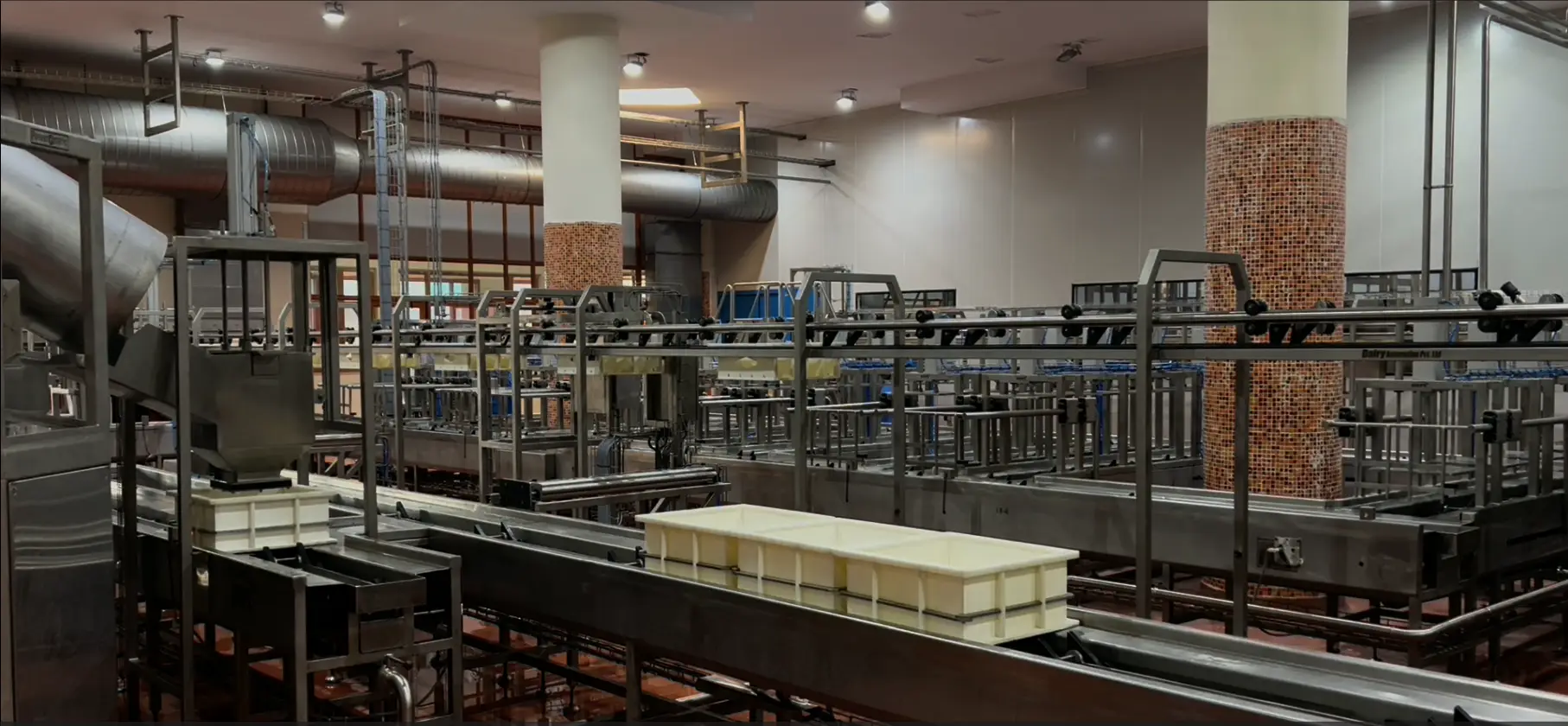
Dairy Automation Pvt. Ltd. (DAPL) manufactures paneer pressing systems based on this progressive pressing technology, where pressure is applied in controlled stages. This approach supports better curd consolidation and helps dairies produce paneer blocks with consistent shape, texture, and structure.
Conclusion
Pressing is one of the most critical steps in paneer manufacturing. Manual pressing methods often lead to uneven pressure, which can affect moisture distribution and paneer texture.
Controlled and progressive pressing methods help improve consistency by regulating pressure during the pressing stage. By applying pressure gradually, dairies can achieve uniform paneer blocks with stable texture and reliable product quality.