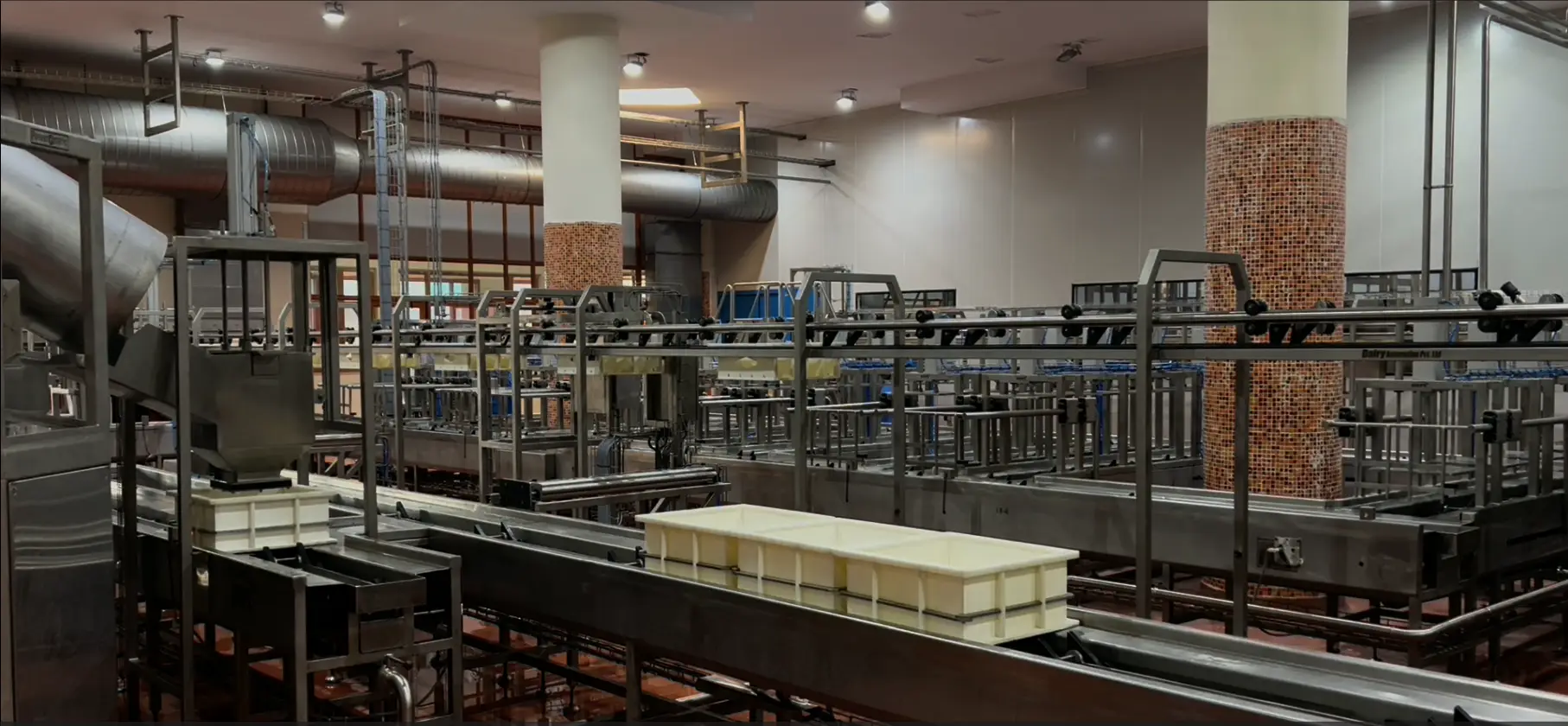
April 1, 2026
Complete Guide to Setting Up an Automated Paneer Manufacturing Plant 2026
India is the world’s largest producer and consumer of paneer — and global demand is only growing. With the paneer market valued at over $12 billion in 2025, dairies of all sizes are under pressure to produce more, cleaner, and faster. Whether you are setting up your first dedicated paneer line or upgrading an existing one, this guide walks you through every stage of a modern automated paneer manufacturing plant — from milk intake to the final cut block.
Why Automate Paneer Production?
Manual paneer-making — open vats, hand stirring, labour-intensive pressing — creates three problems that get worse as you scale:
|
📉 Inconsistent Yield Uncontrolled coagulation leads to lower and unpredictable paneer yield batch to batch. |
🧫 Hygiene Gaps Manual handling increases contamination risk, shortening shelf life and increasing rejections. |
💸 High Labour Costs Margins shrink as you scale, especially when competing on retail and export pricing. |
Automated paneer plants solve all three. They deliver consistent quality batch after batch, reduce direct labour on the production floor, and produce paneer that meets hygiene standards required for modern retail, foodservice, and export markets.
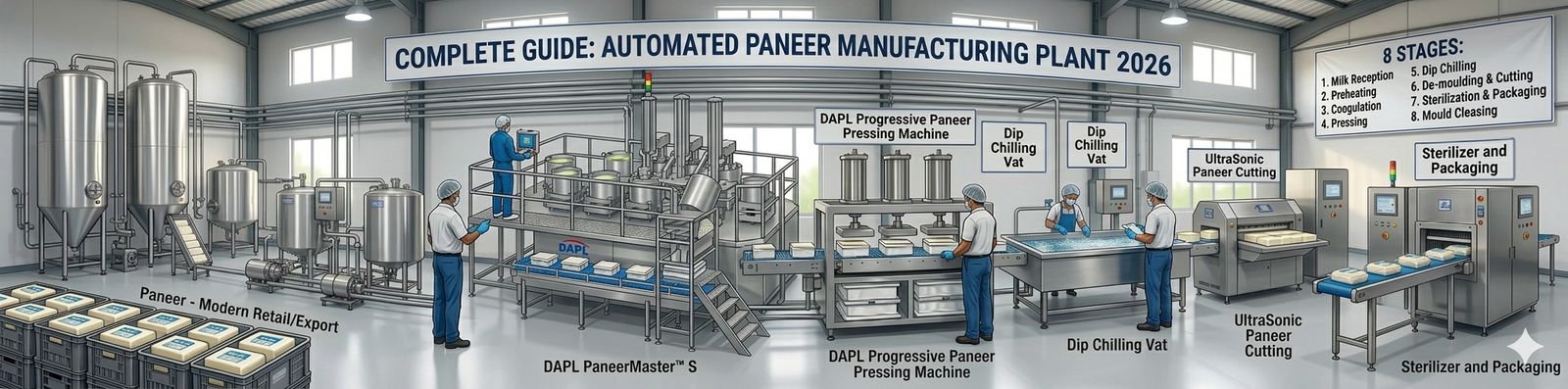
The 8 Stages of an Automated Paneer Manufacturing Line
Here is a quick overview of the full production flow:
Stage 1 — Milk Reception and Storage
Quality paneer starts with quality milk. Raw milk is received, tested for fat and SNF content, then stored in insulated silos at 4–6°C. Food-grade SS 316 tanks with agitators and temperature sensors are standard. A good rule of thumb: size your milk storage at 1.5× your planned hourly processing rate.
Stage 2 — Milk Preheating
Milk must be heated to exactly 85–90°C before coagulation. This step is critical for paneer yield — heat denaturation of whey proteins causes them to co-precipitate with casein, directly improving the mass of curd formed. A ±1°C variance at this stage can result in a 3–5% yield drop per batch.
DAPL’s Milk Preheater uses a tubular heat exchanger design with an energy recovery circuit, reducing thermal energy consumption while maintaining a consistent supply to the coagulation system.
Stage 3 — Coagulation: The Heart of Paneer Production
An acidulant — citric acid solution, lactic acid, or whey — is dosed into heated milk to drop the pH to approximately 5.3–5.5, causing casein proteins to form curd. In manual systems, timing, acid dosing, and agitation vary from operator to operator. Automation makes every batch identical.
PaneerMaster™ — Automated Paneer Coagulator
Patented rotary continuous coagulation system by DAPL
| ✓Continuous operation for uninterrupted production and higher throughput |
| ✓“One Vat, One Mould” design — uniform texture, shape, and moisture in every block |
| ✓Integrated de-vat system for smooth, hygienic curd transfer with minimal handling |
| ✓Automated milk filling, acidification, agitation, and whey extraction |
Available capacity configurations:
Stage 4 — Pressing
After coagulation, curd is transferred into micro-perforated moulds and pressed to remove excess whey and form solid blocks. Pressing parameters — pressure, dwell time, and sequence — directly determine the final moisture content and texture of your paneer.
DAPL’s Progressive Paneer Pressing Machine
|
4-Stage Progressive Pressing System Ensures uniform curd consolidation and controlled whey drainage at every stage. |
Seamless Line Integration Compatible with semi & fully automated inline paneer manufacturing lines. |
|
Automated Mould Handling Optional mould lid lifting with automatic unloading supports continuous paneer production. |
PLC-Controlled Pneumatic Pressing Precise pressure, dwell time, and sequence — consistent results every batch. |
Stage 5 — Dip Chilling
Pressed paneer must cool rapidly from ~55–60°C to below 4°C to halt microbial activity and set the texture. Even 30 extra minutes at elevated temperature post-pressing can significantly increase microbial load — cutting shelf life before the product leaves the plant.
DAPL’s Dip Chilling Vat uses RO-chilled water circulation with in-mould immersion — preserving block shape, preventing surface cracking, and eliminating direct water contact with the product.
Stage 6 — De-moulding and Cutting
Chilled blocks are de-moulded and portioned to your required SKU specifications — 200g, 500g, 1kg retail blocks or bulk 2–5kg slabs for foodservice. DAPL’s UltraSonic Paneer Cutting and Portioning Machine handles 500–2,000 kg/hr using servo-controlled blades that produce clean, consistent cuts with minimal product loss and no surface damage.
Stage 7 — Sterilization and Packaging
For modern retail, e-commerce, or export, shelf life matters. DAPL’s Sterilizer extends paneer shelf life to 45–60 days through a controlled hot water shower and cooling cycle applied post-packaging — without affecting texture or taste. This single step is the most impactful upgrade for any dairy entering organised retail or cross-border trade.
Stage 8 — Mould Cleaning
Micro-perforated paneer moulds need thorough cleaning between every production cycle. DAPL’s Paneer Mould Cleaning Machine processes 25–100 moulds/hr through a fully automated cycle: pre-rinse → detergent wash → hot water rinse → sanitization. Clean moulds mean longer shelf life, better texture consistency, and compliance with food safety audits.
Compliance Standards to Design For From Day One
Build compliance in from the start — retrofitting is expensive. Your paneer plant should meet:
| ✓FSSAI regulations for dairy processing (India) | ✓CODEX Alimentarius CAC/RCP 57-2004 (fresh cheeses) |
| ✓CE Marking — European & Middle Eastern markets | ✓FDA compliance — US market entry |
| ✓ISO 22000 / FSSC 22000 food safety management | ✓RoHS 2 compliance for electrical equipment |
All DAPL equipment carries CE, FDA, FSSC 22000, and RoHS 2 certifications — so your compliance pathway is significantly simplified at installation and during export market entry.
Quick Capacity Planning Guide
10 litres of standardised milk yields approximately 1.6–1.8 kg of paneer depending on fat content and coagulation efficiency.
Frequently Asked Questions
Ready to Plan Your Paneer Plant?
DAPL has delivered turnkey paneer plant projects across 20+ countries — from mid-scale cooperative dairies to large commercial plants processing over 1,000 kg/hr.
| ✉ sales@dairyautomation.com | 📞 +91 91369 58143 | 🌐 dairyautomation.com |